For commercial buildings, choosing a solar power system is about more than installing panels on the roof. Businesses need to consider electricity costs, operating hours, grid reliability, available roof space, and how much power must remain available when the sun goes down. Two common options are commercial on-grid solar systems and hybrid commercial solar systems.
Both can help reduce dependence on utility electricity, but they work differently. An on-grid system focuses on using solar power alongside the utility grid, while a hybrid system adds battery storage to give businesses more control over when solar energy is used. Understanding these differences helps building owners, facility managers, and project developers choose a system that fits their actual operating needs.
1. What Is a Commercial On-Grid Solar System?
A commercial on-grid solar system connects photovoltaic panels to a building's electrical system and the local utility grid. During daylight hours, solar panels generate electricity that can be used directly by the building's equipment, lighting, HVAC systems, computers, and production machinery.
When solar generation is lower than demand, the building can draw additional electricity from the grid. If the system produces more electricity than the building consumes, the surplus may be exported to the grid, depending on local regulations and the utility's compensation policy.
The main advantage of commercial on-grid solar is its relatively straightforward design. Since a conventional grid-connected system does not require batteries, the initial investment can be lower than that of a comparable hybrid installation. There is also no battery capacity to size or replace as part of the original system design.
This arrangement is often suitable for office buildings, retail facilities, schools, warehouses, and factories that consume substantial electricity during daylight hours and have a reliable utility connection.
Businesses evaluating grid-connected options can explore on-grid solar systems to understand the available system configurations.
2. What Is a Hybrid Commercial Solar System?
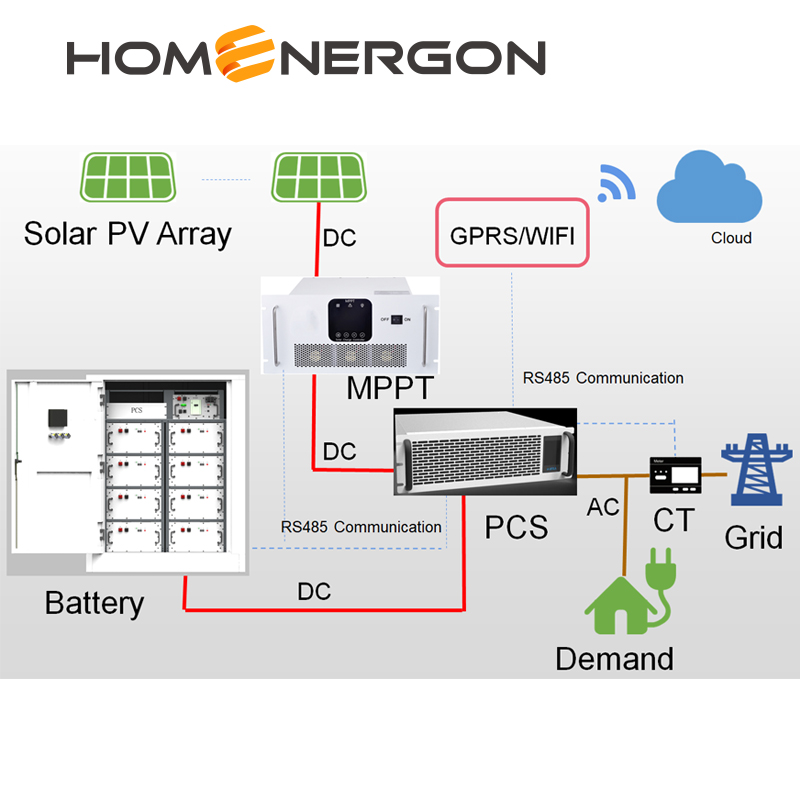
A hybrid commercial solar system combines solar panels, a compatible inverter, battery storage, and usually a utility grid connection. It can supply building loads directly from solar generation, charge the battery with surplus electricity, and use stored energy when solar production falls or electricity costs are higher.
The exact operating modes depend on the inverter, battery management system, electrical design, and local grid requirements. A properly configured system may also support selected loads during a grid outage. However, backup operation is not automatic for every grid-connected installation. The equipment must support islanding or backup mode, and the system needs appropriate protection and transfer arrangements.
A hybrid commercial solar system can be attractive for businesses with evening demand, variable electricity tariffs, peak-demand charges, or a need for additional power resilience. For example, a warehouse may generate more solar electricity than it needs around midday but still require substantial power for evening operations. Battery storage can shift some of that daytime energy to a later period.
Businesses can review Homenergon's commercial solar systems for integrated solar and storage options.
3. On-Grid vs. Hybrid Solar: Key Differences
The right choice depends on how a building uses electricity and what it expects the solar installation to achieve. The following comparison summarizes the main differences.
| Factor | On-Grid Solar | Hybrid Solar |
|---|---|---|
| Battery storage | Not required | Included when storage is specified |
| Initial investment | Usually lower | Usually higher |
| Use solar energy after sunset | Requires grid electricity or another source | Possible using stored energy |
| Grid outage support | Typically shuts down unless specifically designed otherwise | Possible for supported backup loads |
| System complexity | Generally simpler | More components and controls |
| Energy management | Primarily uses solar when generated | Can shift energy use with storage controls |
One important point: a standard grid-connected solar inverter generally stops exporting power during a grid failure for safety reasons. Installing solar panels alone does not guarantee that a building will have electricity during an outage. Hybrid systems also need suitable backup functionality and correct electrical configuration to provide power safely.
4. When Is On-Grid Solar the Better Choice?
On-grid solar is often a practical option when a business wants to reduce daytime electricity purchases without adding battery storage. It can work particularly well for buildings with consistent daytime demand, such as offices, shopping facilities, workshops, and factories operating mainly during daylight hours.
Before choosing this configuration, review the building's electricity bills and interval consumption data. If the site uses most of its electricity while the panels are producing power, a larger share of solar generation may be consumed directly on-site. This can improve the financial value of the system.
Also check the local rules for grid connection, export limits, and compensation for surplus electricity. In some markets, exporting excess generation earns less than the retail electricity price. In others, export restrictions may affect system sizing. These details can change the expected payback period significantly.
For projects where capital expenditure is the main concern and backup power is not essential, an on-grid system may offer a simpler starting point.
5. When Should a Business Consider Hybrid Solar?
Hybrid solar becomes more relevant when a building needs to use solar energy beyond daylight hours or wants to manage selected electrical loads during grid interruptions. It may suit facilities with evening shifts, refrigeration, production lines, communications equipment, or other loads where interruptions can be costly.
Battery storage can also help shift solar energy away from periods of low demand. Depending on the local tariff structure, a battery may be charged when electricity is inexpensive or solar generation is high, then discharged during more expensive periods. Whether this strategy saves money depends on tariff rules, battery efficiency, system control settings, and the cost of storage.
Not every building needs to back up its entire electrical load. In many commercial projects, it is more economical to identify essential circuits and size the battery around those loads. Critical equipment, emergency lighting, network systems, and selected control systems may have different backup requirements from air conditioning or heavy machinery.
When evaluating a commercial solar battery, consider usable energy capacity, maximum charge and discharge power, operating temperature, expected cycling, warranty conditions, and compatibility with the inverter. Battery capacity is measured in kilowatt-hours (kWh), while power is measured in kilowatts (kW). Both figures matter: a battery may store enough energy but still be unable to support a high-power load.
6. How to Size a Commercial Solar and Battery System
System sizing should start with the building's actual load profile rather than the roof area alone. A qualified installer or project engineer can use electricity bills, interval meter data, operating schedules, and site conditions to estimate an appropriate system size.
- Review daytime demand: Determine how much electricity the building consumes while solar panels are producing power.
- Assess the roof or site: Check usable space, shading, structural capacity, orientation, and local weather conditions.
- Define backup loads: List the equipment that must remain powered during an outage and calculate its starting and running power requirements.
- Estimate storage needs: Calculate how many kWh are required over the intended backup period, allowing for usable battery capacity and conversion losses.
- Check electrical compatibility: Confirm inverter output, voltage, phase configuration, protection devices, and grid interconnection requirements.
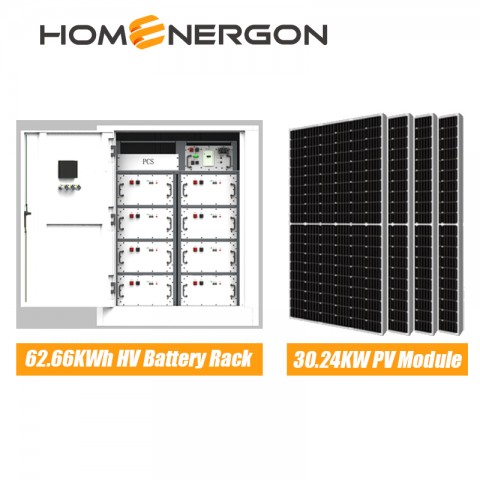
For example, Homenergon lists a 30kW commercial storage system with a stated battery energy of 62.66kWh. This provides a reference point for project discussions, but it should not be treated as a universal solution for every building. The appropriate configuration depends on the site's load profile, required backup duration, and operating conditions.
Businesses comparing storage components can also review the 51.2V LiFePO4 battery pack for battery specifications and application considerations. A battery pack intended for a particular system should only be selected after confirming voltage, current, control communication, and inverter compatibility.
7. What About Cost and Return on Investment?
On-grid systems generally have a lower upfront cost because they do not require battery storage. Their financial performance is mainly influenced by installed system cost, solar yield, the proportion of electricity consumed on-site, electricity prices, export compensation, and maintenance.
Hybrid systems add battery and control equipment, increasing initial expenditure. In return, they may provide additional value through time-shifting solar energy, reducing grid purchases during expensive periods, or supporting selected loads during outages. The value of backup power can be difficult to capture in a simple payback calculation, especially when it prevents production losses or protects temperature-sensitive inventory.
Ask suppliers to model both configurations using the same site consumption data and clearly stated assumptions. The comparison should include battery replacement or warranty limits where applicable, electricity tariff changes, expected degradation, and the cost of any required electrical upgrades. Avoid choosing a system based only on panel capacity or battery size.
8. Which Solar System Is Right for Your Commercial Building?
For a business with strong daytime electricity demand, a stable grid connection, and no major need for backup, commercial on-grid solar may be the most cost-effective option. For a site with substantial evening demand, time-of-use tariffs, or a need to keep selected equipment running during outages, a hybrid system deserves closer evaluation.
The best choice comes from matching the system to the building's real energy use—not simply installing the largest array or battery available. Review load data, local grid rules, backup requirements, and the expected financial return before finalizing the design.
Homenergon develops solar power and energy storage solutions for residential and commercial applications. Learn more about the company and its product range on the Homenergon official website, or contact the team to discuss system configurations for your project.
Frequently Asked Questions
1. What is the main difference between on-grid and hybrid commercial solar?
On-grid solar works with the utility grid and typically has no battery storage. Hybrid commercial solar combines grid connection with battery storage, allowing excess solar energy to be stored for later use and potentially providing backup power when the system is designed for it.
2. Can an on-grid solar system power a commercial building during a blackout?
A standard grid-tied inverter usually shuts down during a grid outage for safety. Backup power requires equipment and electrical arrangements specifically designed for that purpose, such as a compatible hybrid inverter, storage, and approved backup circuits.
3. Is a commercial solar battery worth the extra cost?
It depends on electricity tariffs, evening consumption, export compensation, backup needs, and battery costs. Storage may improve savings where peak electricity prices are high or solar energy would otherwise be exported at a low rate. A project-specific financial model is the best way to compare options.
4. How large should a hybrid commercial solar system be?
System size depends on the building's electricity demand, available installation area, solar resource, and backup requirements. Review interval consumption data and identify essential loads before deciding on PV capacity, inverter power, and battery energy.
5. Can a commercial solar system be expanded later?
Some systems can be expanded, but this depends on inverter capacity, battery compatibility, electrical infrastructure, and local interconnection rules. If future expansion is likely, discuss it during the initial design so the system can accommodate planned additional capacity where practical.